The Economic and Clinical Trade-offs
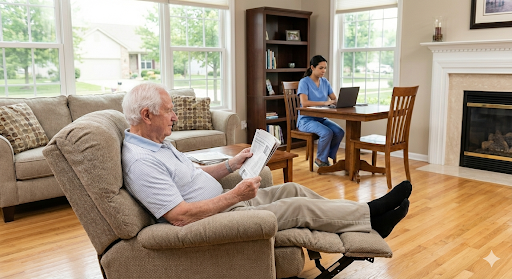
When a loved one requires around-the-clock supervision—perhaps due to advanced Alzheimer’s or severe mobility restrictions—families are often faced with a binary choice: a nursing facility or 24-hour home care.
While facilities have been the traditional route, the "paradigm shift" is moving heavily toward live-in care.
This shift is driven by a granular analysis of both clinical outcomes and quality of life. While facilities offer economy of scale, they often lack the "personalized environmental engineering" that a home setting provides.
Minimizing Cognitive Disorientation
For seniors with cognitive decline, "place" is a critical anchor. Moving a dementia patient to a facility strips them of the environmental cues (the location of the bathroom, the view from the window, the smell of the kitchen) that help them navigate the world. This often precipitates a rapid decline known as "transfer trauma."
The Home Advantage: 24-hour live-in care preserves the senior's connection to their history. They remain in the environment where they formed their memories, which significantly reduces anxiety and the need for pharmaceutical sedation.
The Risk of Nosocomial Infections
One of the most compelling arguments for home care is the reduction of infection risk. Nursing facilities, by their nature, congregate vulnerable people. This creates a breeding ground for viruses and antibiotic-resistant bacteria (nosocomial infections).
The Home Advantage: In a private home, the environment is controlled. Exposure to pathogens is drastically lower. A dedicated live-in caregiver from Comfort Angels Home Care focuses on one patient, not fifteen, ensuring rigorous hygiene standards are met.
One-on-One Ratios vs. Institutional Staffing
In a facility, staff-to-patient ratios can be 1:10 or higher. This means a senior may wait 45 minutes for help to the bathroom, increasing the risk of falls or incontinence episodes.
The Home Advantage: Live-in care offers a 1:1 ratio. The response to a need—whether it's a glass of water, help to the toilet, or simple comfort during a moment of confusion—is immediate. This level of responsiveness is virtually impossible to replicate in an institutional setting.
The Cost-Benefit Analysis
While 24-hour care is an investment, it often compares favorably to the cost of a high-quality private room in a nursing facility, especially when couples are cared for together.
When factored against the "silent costs" of institutionalization—loss of dignity, rapid decline, and hospital readmissions—home care frequently emerges as the superior value proposition.