Neuroplasticity and the Aging Brain
For decades, it was believed that the aging brain could only decline. However, modern neuroscience has revealed the concept of neuroplasticity—the brain's ability to form new neural connections even late in life. While we cannot stop the structural changes of aging (like the reduction in prefrontal cortex volume), we can stimulate the brain to bypass damaged areas and maintain function.
The key is "active engagement." Passive activities, like watching hours of television, have been shown to accelerate cognitive decline. In contrast, interactive activities act as "mental gymnastics," strengthening the synaptic connections that support memory and executive function.
Targeted Activities for Home Care
A robust home care plan includes "environmental engineering" that incorporates cognitive stimulation into the daily routine.
Reminiscence Therapy (The "Retrieval" Workout)
The Activity
Going through old photo albums or listening to music from the senior's youth.
The Science
This targets long-term memory storage, which often remains intact even when short-term memory fails.
It strengthens the emotional centers of the brain and improves mood.
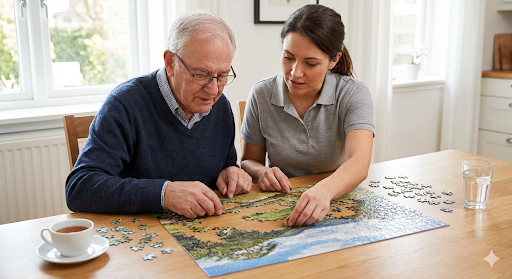
Puzzles and Sorting (Executive Function)
The Activity
Sorting coins, folding laundry, or simple jigsaw puzzles.
The Science
These tasks require planning, pattern recognition, and fine motor skills.
They engage the frontal lobes, helping to maintain the ability to sequence tasks.
Art and Music (Sensory Stimulation)
The Activity
Painting, coloring, or singing.
The Science
These activities bypass the language centers (which may be affected by aphasia) and access the creative, emotional brain.
This is particularly effective for those with dementia who struggle with words but can still hum a tune.
The Role of the Caregiver
It is difficult for a senior with "age-associated memory impairment" to initiate these activities on their own. Inertia often takes over.
A Comfort Angels Home Care professional serves as the catalyst. We set up the activity, provide the necessary cues, and offer encouragement, turning a potentially frustrating task into a shared success.