The Prerequisites for Aging in Place
The research is clear: the vast majority of seniors prefer "aging in place"—the ability to live in one’s own home and community safely and independently. However, this preference must be supported by a rigorous approach to environmental engineering. As physical capabilities change, the home environment must evolve to match them. If it does not, the home can transform from a sanctuary into a landscape of hazards.
Falls are not merely accidents; they are often the precipitating event for a cascade of health declines, leading to hospitalization and, frequently, a permanent loss of autonomy. Therefore, creating a fall-resistant environment is one of the most critical operational steps a family can take.
Need a safety partner? Learn about our Companionship Care to ensure your loved one is never alone in a crisis.
Environmental Engineering: A Room-by-Room Analysis
To mitigate these risks, we must look at the home through the lens of a geriatric safety audit.
The Pathways (Hallways and Living Areas)
The Hazard
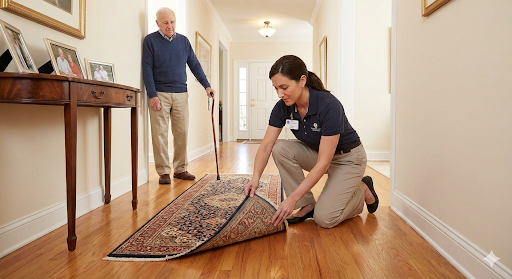
Clutter and loose rugs are the enemies of stability. For a senior with a shuffling gait (common in Parkinson’s) or slower reaction times (normal senescence), a throw rug is a major trip hazard.
The Fix
Remove all throw rugs or secure them with industrial double-sided tape. Ensure pathways are wide enough for a walker or wheelchair, anticipating future mobility needs.
The Bathroom (The High-Risk Zone)
The Hazard
Slick surfaces combined with the physical effort of sitting and standing make this the most dangerous room in the house.
The Fix
Install grab bars—not suction cup handles, but bars bolted into studs—near the toilet and in the shower. Consider a shower chair to reduce fatigue. Non-slip mats are non-negotiable.
Lighting and Vision
The Hazard
Aging eyes require more light to process depth perception. Dim hallways can hide obstacles.
The Fix
Install motion-sensor night lights along the path from the bedroom to the bathroom. This is critical for seniors who experience "nocturia" (frequent need to urinate at night) and may be groggy.
The Role of Personal Care in Prevention
Environmental changes are only half the battle. The other half is supervision. Many falls occur when a senior attempts a task that exceeds their current ability, such as reaching a high shelf or carrying laundry down stairs.
At Comfort Angels Home Care, our caregivers act as a proactive safety measure.
We handle the physically demanding tasks of housekeeping and provide "stand-by assistance" for mobility. This preserves the senior's dignity—they are still living at home—while removing the specific risks that lead to injury.
Is your home dementia-friendly? Check our guide on 6 Ways to Make Your Home Safe for a Loved One with Dementia.