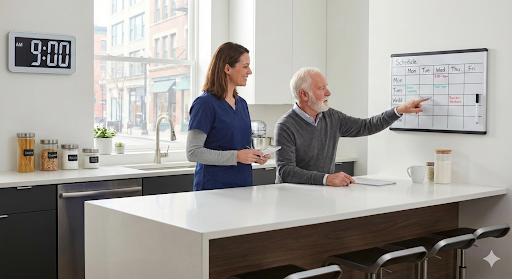
For individuals suffering from the cognitive disorientation associated with Alzheimer’s and dementia, the world can often feel like a chaotic, shifting landscape.
As the brain’s ability to retain new information ("storage deficit") and retrieve past memories ("retrieval deficit") declines, the environment becomes increasingly difficult to navigate. In this context, a structured daily routine acts as an essential anchor.
Current research in geriatric care underscores that "environmental engineering" the deliberate structuring of a patient's physical and temporal surroundings—is a clinically viable alternative to heavy sedation or institutionalization.
A predictable routine serves as a "prosthetic memory," allowing the individual to function on autopilot even when executive function—the ability to plan and organize—is compromised.
Looking for comprehensive home support? Visit our Services Page to find the right care plan for your family.
Reducing the "Fight or Flight" Response
When a person with Alzheimer's cannot predict what will happen next, they often enter a state of hyper-arousal or anxiety. This can manifest as agitation, wandering, or aggression—behaviors often triggered by fear rather than pathology alone.
By regularizing daily events (waking, meals, hygiene, rest), we reduce the cognitive load on the patient.
They no longer have to expend energy trying to figure out "what comes next," which lowers cortisol levels and promotes a sense of safety.
Designing a Therapeutic Routine
A successful home-based care plan involves more than just a schedule; it involves aligning activities with the senior's natural circadian rhythms and remaining abilities.
Morning (The High-Energy Window)
Most cognitive reserves are highest in the morning. This is the ideal time for tasks requiring effort, such as bathing or dressing.
Mid-Day (Engagement)
To prevent social isolation, structured activities should occur here. This might involve simple, repetitive tasks that provide a sense of purpose without improved "executive function" demands.
Late Afternoon (The Sundowning Period)
As fatigue sets in, the risk of "sundowning" (increased confusion and restlessness) rises. The routine should shift toward low-stimulation activities, reduced lighting, and calming music to prepare the brain for rest.
The Role of Professional Care
Implementing this level of consistency can be exhausting for family caregivers who are balancing their own lives. This is where Comfort Angels Home Care steps in. We do not just "watch" your loved one; we engineer a day that maximizes their remaining independence while ensuring safety.
Our caregivers are trained to distinguish between a "bad day" and a pathological decline, adjusting the routine subtly to match the senior’s immediate needs.
Whether it is ensuring hydration to prevent the silent epidemic of senior dehydration or managing the "first 72 hours" of a new medication, our team provides the sophisticated infrastructure needed for aging in place.